Monday, 2 April 2012

14 Border Crossing from Chile for the last time: Junin, Volcano Lanin and the Lanin National Park

 Tuesday, March 20th to Thursday, March 22nd

(Illustrated with borrowed photos, following theft of camera)

Today there were some outstanding views of two volcanoes: in particular, on such a cool clear morning, the gas from the still erupting Volcano Villarica could be seen quite clearly, culminating in a large cloud somewhere above it. On such a beautiful day, it seemed a shame to be on a bus, but at least I couldn't complain that I was unable to see anything. (Many lost photos!) With a stop beside a pretty river, nobody seemed in a hurry to get back on the bus and continue to the border  - not even the driver.

The border guards would have had the benefit of amazing views of Volcan Lanin normally, as well as a pleasant outlook onto a pretty monkey puzzle tree just outside. But today, the cloud decided to come down on the mountain just as we reached the border, and even with the inevitable delays, it refused to leave the mountain top.

Monkey puzzle tree: photo Jan

Lanin Volcano. Photo Paulo Roberto - see below
While waiting, and idly flicking through the pages of my passport, I suddenly noticed something odd. For the most part, exits from Argentina were paired with entries to Chile, and vice versa. But what was this? How could I possibly have entered Argentina on 1st December 2012, when it was now only March 2012? My actual first date of entry was 8th January, which was correctly recorded!

Working it out, I traced the stamp to the sleepy border guards at Lago Desierto, where six of us had camped at the border post, on the night prior to trekking 7 hours to cross from Argentina into Chile, and then onto the next Chilean border office. (See post 05, border crossing.)

This being 1st February, the guard had evidently correctly changed the day from 31 to 1, and intended to change January to February. He had evidently moved the month section the wrong way, and changed it to December, instead! (Well, it would only have been 8.30 in the morning, and with 6 campers to check out of Argentina,  the poor guy must have been under pressure, what with dogs and chickens to feed - maybe - before the 10:30 boat got in. He could also have been stressed by being more than half-an-hour late opening the office, having probably stayed up half the night watching TV - and maybe he hadn't yet had his coffee!) Thankfully (surprisingly or not), this bogos date hadn't been picked up by any subsequent border guards - or if it had been, they had wisely decided to ignore it.

After the border today, the scenery changed dramatically, from the very wooded scenery on the Chilean side (monkey puzzle and other), to a landscape with few trees, but with mountains and rock formations shaped in a way that was slightly reminiscent of photographs I had seen of North American national parks. (Please, has anyone got any photos?)

We arrived only an hour late in the small, sleepy town of Junin, and I made my way to the campsite, situated near the river. Here I was forced to communicate in my dodgey Spanish (which had to be good for me), and one of the friendly staff there showed me which part of the site was 'mas seco'.


Looking at the map, I was excited to see a promising looking valley, running north of Lago Huechulafquen: just south of Volcan Lanin. Enquiries revealed that although the road was ripio, it was not too hilly: so I set off to find the cycle hire shop. In this town, nearly everyone was on a bike (sometimes with 2 or 3 people to one), so things looked hopeful: besides which, the town had a 'feel good' atmosphere, making me feel that this could be the perfect place to end my trip.

However, it was not to be. There was only one cycle hire shop in town, near the bus station. (Separate from the busy cycle repair shop - take note, Vicky and Henrique!) Furthermore, the bikes they had for hire were in worse condition than the average one dumped at my local recycling centre, despite being the most expensive I was to see in Chile!

The one bicycle they had that was anywhere near my size had an unimaginable saddle, and the gear 'box' on the handlebars wasn't even covered. I could not imagine going even a mile on it, though it would have done for just knocking around the little town, I suppose. Deciding to delay the decision until I had explored other options, I wandered down to the river, where I watched a fisherman on the other side, as he threw in his line, then took to playing his mouthorgan, while waiting for the fish to think about biting.

Back at the campsite, a friendly couple in a campervan came and introduced themselves as Jan and Aurelie. They were both mechanical engineers, working as product managers for a company on the French/German border, and were on a year's sabbatical for travelling. http://aurelieundjan.webnode.com/uber-uns .We chatted for a while, and they told me they were going to go and camp at one of the many campsites in the National Park the next day, ready to walk up to the base of the Lanin Volcano the following day.  I was welcome to go with them, though they might be going from there directly on to Pucon. Perfect!

Next day was beautiful, and after a quick visit to the supermarket to get supplies, we were off. The van was not a 4-wheel drive, so Jan took it very slowly, and with clear blue skies, we stopped occasionally to admire the lake, the volcano and the  shape of the mountains - and for photos (ouch!).
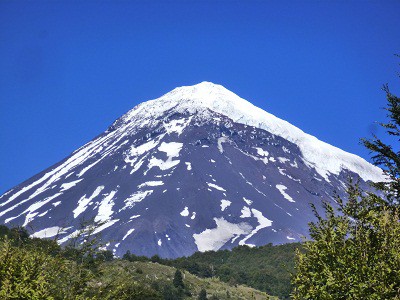
Volcan Lanin (photo Jan)
It cost us 50$ each (approximately 8GBP) for National Park entrance, but at the campsite, there were no further charges: the season was over, and although there was still hot water (you could see the steam coming out of a tank on stilts), there was nobody to collect camp fees. A lovely peaceful campsite situated near a lake, and with views of the snowy volcano Lanin to die for, monkey puzzle trees, chickens running around - and a small dog with almost irresistable pleading eyes: one of many that seemed to be everywhere in Argentina.

Araucaria (monkey puzzle) trees -  Photo Jan
 

Aurelie had a headache and needed to rest, so I took myself off up the track to look at the El Saltillo waterfall: spectacular, with the water pouring down from the volcano, through some rocks to a river below. http://irudi.photoshelter.com/image/I0000s6STN_Ap8SM (follow link for photo).

Notices explained that the area had its own microclimate, ideal for plants and animals. It also warned of an insect whose sting/bite could hurt. (You were advised to take precautions if you were allergic to it, but that was something you were unlikely to know, unless you were from South America.)

The trees here were nicely spaced out, so that they let some sun through. Near the waterfall, the rock formations were spectacular, with sobering evidence of major landslides all around. Later, as the sun went down, we were treated to a beautifully pink view of the snowy volcano: a photographer's delight.

Lanin Volcano - photo Jan
Later, at the campsite, Aurelie was feeling better, and Jan got a fire going, on which to barbecue some beef for us all. They had WOOFFed for a while on an estancia, when they first arrived in Argentina. Here they had been told that the best way to barbecue beef was slowly, with only salt. A couple of hours later, we feasted under a sky full of stars, on beef, salad, bread and wine. All the while, we were watched by the little dog . . . .

With the food and the wine, it did not take me long to get to sleep that night. But sometime a few hours later, something woke me. The first thought that hit me, was how snug I was - my feet in particular. But what was that? Something was resting against my feet - something that moved!

I sat bolt upright - but there was nothing inside the tent.  Cautiously lying down again, it suddenly hit me - could it be the little dog?  But if so, where was he? He definitely wasn't inside the tent. And if it wasn't the dog, then  what on earth was it? It was something live, because I could feel it breathing! I jerked my feet, and whatever it was, was launched into mid-air. I went back to sleep - or nearly. Five minutes later, I felt something curl up again, but I was too tired to bother about it - at least whatever it was was warm.

Next morning, with my live 'hot water bottle' still in place, I slowly withdrew  my feet and manoevered myself to the tent door, peering cautiously round the corner, to the back of the tent. Sure enough, there was the little dog, sleeping - curled up against where my feet had been! It was not until I started taking the tent down that he finally woke up, and then went bounding over to Auchalie, as she emerged from the camper van.

Today, the sky was an even deeper blue than the day before, and after registering at the National Park office (here in Chile, they were very safety conscious, and for many treks it was compulsory to register your intention, and then sign back out when you got back). We were told that the trek up to the volcano base and back should take about 7 hours: pretty accurate, as it happened: the first half did in fact take 2 hours, as estimated - though we made up time on the steeper second part. Walking  fast, as we were, we were up and down within the 7 hours, even with quite a long lunch stop at the top, enjoying the stunning views of the snow, and the rock formations either side of the volcano. 


At the start of the hike: with Aurelie (photo Jan)
Jan (photo Aurelie)
 Though the first part was through trees, the forestry here was not as dense as in many other areas I had visited, allowing the sun to get through, as well as occasional views of the volcano - even in the first part, as we followed the river up. As we neared the base, we passed through a section strewn with volcanic and other rock of all shapes and sizes.
Volcan Lanin (photo Jan)
For more photos, see http://www.superstock.com/stock-photography/Watkins

Down again, we went to sign off, and found that the staff had left for the day, but left the list of names to be signed off. At first I didn't appear to be on it. But then, next to the other two's names, I saw that there was someone called A Rozxva (or something similar), from the UK - it could only be me!

We returned to the campsite in Junin: the others had decided to have another night there before going on to Pucon. For my part, I decided that I really did want another day on a bike, so I would take the evening bus just an hour up the road to St Martin, where there would be a lot more options.

Having collected the rest of my stuff, and booked myself into the 'Puma' hostel in St Martin de los Andes by phone, I said goodbye to Jan and Aurelie, loaded up once more, and walked the 20 minutes to the bus station.

As I arrived, one of the men from the campsite reception came running towards me. He had left a paper for me at the booking office, he said. Puzzled, I followed him: he had marked a map of St Martin with the exact location of the hostel, and torn down to the bus station with it - probably in a car! Just another example of the kindness of these people. (I already had a map, but of course I didn't tell him that.) And so, to my last couple of days in Patagonia, before heading back to Buenos Aires . . .

13 Valdivia and Pucon

Friday 16th March to  Monday 19th March, 2012

(No photos of my own, following theft of camera.)

Valdivia is a university town set on two rivers, close to the coast. Its major tourist attraction is the fish market, where sea lions hang around all day: their major activity being at around 3pm, when the clearing up takes place, and 'scraps' (bigger than the average fish meal, in some cases), are thrown out to the animals, which are watched by an admiring crowd: almost like being at a zoo.
http://www.allsouthernchile.com/valdivia-chile.html (for other people's pictures)

With the weather at Puerto Varas having suddenly turned damp and misty, it seemed like a good morning to spend on a bus. By the time we got to the outskirts, where herons could be seen  on the water, it was again warm and sunny.

Checked in at a very pleasant hostel, and had a lovely relaxing afternoon watching sealions, as well as a rowing regatta that was taking place - to the lively accompaniment of a Latin American band on the opposite side of the river to the fish market - enjoyed by a crowd that included equally lively Austral University students, dancing spontaneously to the music. (Sick that I'm unable to upload the video clip I took, and that I no longer even have the book which said what the type the music was, and the name of the group.)

Enjoyed the afternoon so much that I changed my plan and stayed an extra night. (Only partly to do with the amazing breakfast of yogurt with fresh fruit and nutmeg, crepes, fresh bread, jam and real coffee.) Took a short bus ride to Niebla, on the coast, and from there it was just a few minutes by ferry to the island of Corral: probably not seen at its best, since it was once again misty -  though it was quite fascinating to watch a couple of cows harnessed to a cart being driven up the road, transporting tree trunks for construction. Altogether, Corral was a funny little place with a fort, and a tiny museum cum tourist office: If I understood the girls in there correctly, there used to be a piano on the island; but just one, and that one was no longer there. Nevertheless, the museum displayed a copy of the music from Bizet's Carmen. (Believe that's what it was, but having lost my diary, I'm relying on memory.)

Back in Valdivia, a group of fiver or six students dressed in black university gowns sang and played for me in the street - they had been about to pack up and move on. They had been performing together for two years, they told me, some of them studying law, and another one a student nurse. Would they be playing all day? I asked them. Yes, and all night! So no time for studying, I supposed? They  laughed. Again, they were good - but no video clip to upload! (See Ḿajor Mishap post.)

Afterwards, went for a look at the natural history, modern art and anthropology museums in the Isla Teja park, site of the University of Austral, and enjoying some of the graffiti on the side of the modern art museum - probably more than the items inside it!

http://gosouthamerica.about.com/gi/o.htm?zi=1/XJ&zTi=1&sdn=gosouthamerica&cdn=travel&tm=157&f=00&su=p531.56.342.ip_&tt=11&bt=1&bts=1&zu=http%3A//www.interpatagonia.com.ar/paseos/vanmaele/index_i.html

Here, even the lamp-posts were decorated with colourful squares of wool, made into a wrap-around. They reminded me of the coloured woollen squares that we were encouraged as kids to knit, to be made up into blankets.

Took morning bus to Pucon the next day, with its live volcano (Villarica) and black volcanic sand (sadly, with hotels built on it). Original plan was to move straight on to Junin de los Andes the following day, but since the volcano was partly obscured in cloud, decided next morning to stay on a day - even though I was not planning to climb it. Worth it, not so much for the Huerquehue National Park (http://www.flickr.com/photos/38839711@N00/sets/72157594225527788/ lots of trees, including monkey puzzle trees, and more lakes - though not seen at their best in damp weather, especially in the middle of the afternoon, when torrential rain and a thunderstorm took everyone by surprise), as for the views of the volcano I got from my hospedaje window that evening, when the rain had cleared; and particularly for the views of it the following morning as I was leaving. That morning was cold and clear, giving astounding views of the plume of smoke rising from it. Lost my own photos, but see link below for acknowledgement of photo below:

1
Volcan Villarica (near Pucon)

http://www.google.co.uk/imgres?imgurl=http://hostal-don-juan.minihostels.com/content/images/laserenachile/4bf0a96b0ea0b6389aac6f763c22a589.jpg&imgrefurl=http://hostal-don-juan.minihostels.com/page/villarrica&h=438&w=584&sz=43&tbnid=7_yW8sFJ0cRogM:&tbnh=94&tbnw=125&zoom=1&docid=NMeaudzV4CyThM&hl=en&sa=X&ei=NbN3T5XvKOnn0QGz_tDTDQ&sqi=2&ved=0CC8Q9QEwAw

Many people climb this volcano. During the high season, there can apparently be around 500 people on the mountain on any one day. It is considered to be a 'soft' adventure, safe on the whole. Nevertheless, following a tragic accident only three weeks earlier, in which at least two people were killed, and further people injured, there had been some discussion about the experience of some of the guides, the standard of the equipment and the likelihood or otherwise of inexperienced people being able to operate equipment such as ice axes if they actually had to, in an emergency.

All in all, I decided to give it a miss, despite being tempted by the promise of sledging, and the whole experience of activity in the snow with amazing views. Trouble was, with ever changing weather, you couldn't be sure of this - and with a 6.30 start, you couldn't wait until the morning to decide. Instead, I decided to content myself with other people's photographs, since these days I seem to be getting clumsier, and in a way, looking down into the crater of a live volcano seemed to me a bit like looking into the mouth of a crocodile! http://www.volcanodiscovery.com/volcanoes/chile/villarica.html

That said, from the high numbers of people who climb the volcano safely, without incident, it would be a great adventure for the young and fit. (I qualified for the latter, but not for the former, at this stage! Am I getting old and wimpey, or what? Looking at other people's photos, I certainly missed something!)

Monday, 26 March 2012

12 Osorno Volcano: a 3-day bike ride followed by a 3-day trek to Cochamo

Thursday, March 8th to Thursday, 15th March


From Puerto Montt, it's just a short bus ride to Puerto Varas, a smaller town that owes its popularity partly to its spectacular setting on a lake, with a beautifully shaped volcano just behind it, topped with snow.

Volcan Osorno


Here I found the 'Terra Outdoors' bike shop, that not only had bikes to hire, but had one with a rack, enabling me to do a 3-day ride around Lago Llanquihue  (one of the largest lakes in South America), with panniers. Having arranged to pick up the bike the following day, I made my way to a nearby hostel that allowed camping in the garden, with use of bathroom, internet and all indoor facilities: great, since the tent needed to go up to dry out, after that morning's heavy dew. This was to be my base for the next few days, since they were also happy for me to leave unwanted luggage there while I was away. It was managed by Ignacius, originally from Santiago, assisted by Marcos, who made me feel really welcome.

And so I started off on Friday, in 'ideal cycling temperature': though with today's cloud, there were no views of the volcano on the way to Ensanada (not to be confused with empanada, a deep fried savoury pastie).


From Ensanada, it was just 14 km to Lago Todos Los Santos (Emerald Lake) at Petrohue, with a ride through the Peres Rosales National Park, by the side of a beautiful green river, popular for rafting and fishing, and with some interesting rocks.

Lago Todos Los Santos

The road surface was not too great, and there was some major work being done on it, with great chunks of rock being taken out of the surrounding cliffs - but after several weeks in Patagonia, this did not come as a surprise, though riding on sand, as well as gravel, was hard going.

Road to Petrohue


Awkward when a roadworks vehicle breaks down . . .
There are bees, Janet!
The lakeside campsite would have been a nice place to stay, had I not decided to make things easy for myself but leaving the tent behind. Instead, I headed back to Ensenada, to spend the night at the friendly Escala II hospedaje, where since they were nearly full with roadmen who were working away from home, I was given a bed in the deep freeze room: comfortable enough, and the farmhouse-style kitchen-dining room was really cosy. The landlady made me coffee, and produced homemade bread rolls, cheese and local honey, after I got back from a walk to the beach, along a track where bushes were loaded with blackberries: my fruit ration for the day!

Saturday was beautiful, with Volcan Osorno gradually revealing itself as the early morning mist burnt off: a hugely enjoyable day, with stunning views of the volcano, as well as a green lagoon (another Laguna Verde), and Lake Lanquihue itself.

Laguna Verde

Today, much of the road was paved, apart from a section on the way to Las Cascadas, and a gravel road from Puerto Fonk to Puerto Octay: hard for the first few kilometers, but with rewarding views.

This road had been recommended by the guy in Terra Outdoors, the shop that had hired me the bike. As for his other recommendation: good job for him he was away on leave, prior to his wedding, when I got back! The idea of riding up to the base of  Volcan Osorno was not a good one: OK, the first couple of kilometers were rideable, but after that, the road got steeper and steeper, forcing me to push most of the way up to the first mirador, taking a couple of hours. At this point I was just about to turn back, when a middle-aged couple from Buenos Aires arrived, helped me haul the bike into the back of their pick-up truck, and took me with them to the base.

Looking down on Lake Llanquihue 
The black volcanic rock here was interesting to see, and the views down onto the lake, with cotton wool clouds below us, stunning. However, with the road being so steep that I would have had had to use the brakes for most of the ride down, I took up their offer of going down with them as well, so as still to give myself time to get to Puerto Octay.

Volcanic rock near the base of Osorno
From here, the road to Las Cascadas got interesting, and with the weather great, there were good views of the volcano for much of the afternoon.

Derrumbe area, on the way to Las Cascadas
Basaltic rock

With potholes like this, you have to keep your eye on the road
In the early evening light, I cursed myself for leaving the tent behind, as I passed an idyllic camping area at the side of the lake. Still, nothing for it: I continued to the Puerto Octay: a very small town, which now that the season had come to an end, appeared to be sleeping, with very little open.

Dinner that night was rather a bad pastie: the chicken and beef advertised on the board outside were finished, and I was too hungry to go all the way back to the other option in town: a fast food place. However, I compensated for the pastie by going to a small shop that had a small cafe section, selling some completely irresistable cakes. (I still dream about the beautiful orange fondant gateau, and since I had the first  slice out of it, that happened to be a corner piece, I had icing on two sides, as well as on the top!)

Next morning, I was to be glad after all that I hadn't brought the tent: waking to the sound of torrential rain, there seemed to be no point in hurrying to get up, so I allowed myself the luxury of reading in bed. At last the rain eased, and I set off on my way, starting on the main paved road, before taking a gravel road to Frutilla, via Los Bajos: bumpy and hilly. At Los Bajos, it started to rain again, as I headed gratefully towards a cafe: only to find that it was closed. With only a sign advertising apple vinegar for sale, and two churches, there was nothing to keep me there, so after sheltering for a while in a small bus shelter, I battled on.


Frutilla came as a surprise: just a small lakeside town, it had an extremely fancy theatre, and a music school with an excellent reputation, it seemed. I was told later that the theatre was owned by some musicians, who had started the school, and attracted some excellent teachers.  From the posters, there appeared to be just one theatre performance per month - too bad that I had just missed the March performance: had I arrived 24 hours earlier, I could have seen Mary Poppins! That was it, until April . . . .

Frutilla theatre
After the hard ride to Frutilla, I felt I deserved an ice cream, after which I continued by the lake to Llanquihue, on a much easier, paved road. From here, it was just a few kilometres back to Puerto Varas, but I was horrified to find that, since the small road around the road was closed due to more roadworks, the
sign to Puerto Varas appeared to take me straight onto the motorway, with no alternative shown. Surely this couldn't be right? I tried flagging down a couple of cars, to check that I hadn't missed another turning, but they were not stopping. Eventually, a pick-up truck stopped, and reassured me that although not signposted, there was a gravel road over the other side of the bridge. Better still, he was going to Puerto Varas himself, so once again, into the back went the bike (pick-up trucks are just great!), and 20 minutes later, I was in Puerto Varas, returning the bike.

Osorno volcano in a haze caused by volcanic ash from Puyehue, on a day when the wind is blowing the wrong way

Cochamo Trek

After a rest day, I was ready to go again: this time with tent, for a trek up the Cochamo Valley, recommended so warmly by a number of people. With the season at an end, the hostel was nearly empty, so I gratefully took up Ignacius's offer of the use of a small and otherwise empty dormitory for the reduced price of 5,000 pesos  (about 7 GBP), so that I could get my kit organised, and didn't have to pack up a wet tent before going for the 8 o'clock bus.

Away in plenty of time next morning, I was puzzled  to find that by 8 o'clock, there was still no sign of the bus - or of anyone else waiting for it. Checking with the driver of the Ensenada bus, he confirmed that I was in the right place; but then it transpired that my watch had somehow mysteriously lost exactly an hour, sometime between leaving on the 7am bus from Chiloe the previous Thursday, and now - which could account for why the evening had already seemed to be drawing in as early as '7.30' on the night I had got to Puerto Octay!

The next bus to Cochamo did not leave for another three hours, and the one for Ensenada was already full,  but the driver suggested I should get the next one for Ensenada, and try hitching from there. So that's what I did: from Ensenada it was easy, since local people were quick to stop, knowing that there are only three buses a day, and not many other vehicles either. Three rides later, I was at the trail head, having come the last few kilometers in the back of a truck, enjoying the wind and the warmth of the sunshine in my face.

Volcan Yate from Cochamo
I arrived just as Alice, a young Belgian girl, was about to set off, having booked herself into the refugio. We started off together along the muddy, wooded track, which following the previous day's rain, combined with roots, fallen trees and rivers to cross, some of them with dodgey bridges, was quite an obstacle course. An hour or so into the 5-hour walk, we came across Ernan: a 33-year-old snowboarding  instructor and climber from the north of Chile, who having lost his backpack and the kit inside it on a long-distance bus, was loaded down with some weighty kit, packed into a cheap, badly fitting rucksack. He was clearly struggling, having started out an hour earlier than us, and I was reminded of the day in Torres del Paine, when I had nearly given up on the walk up to Seron. Eventually, Alice continued on her own, while I waited for Ernan.

Ernan

At last we got to the campsite at La Junta: a different La Junta from the one on the Carretera Austral, of course! The campsite was in a sunny clearing, favoured mainly by climbers, attracted by the granite rocks that surrounded it: some had been climbing there for as long as three weeks!

Cochamo campsite


Refugio, viewed from above

Apart from the normal wooden shelter, complete with fireplace, there were no facilities other than a tap and a dry loo. (A sign read: "This toilet is for poo poo and toilet paper only. If you want a pee, go find a tree to water.")
  

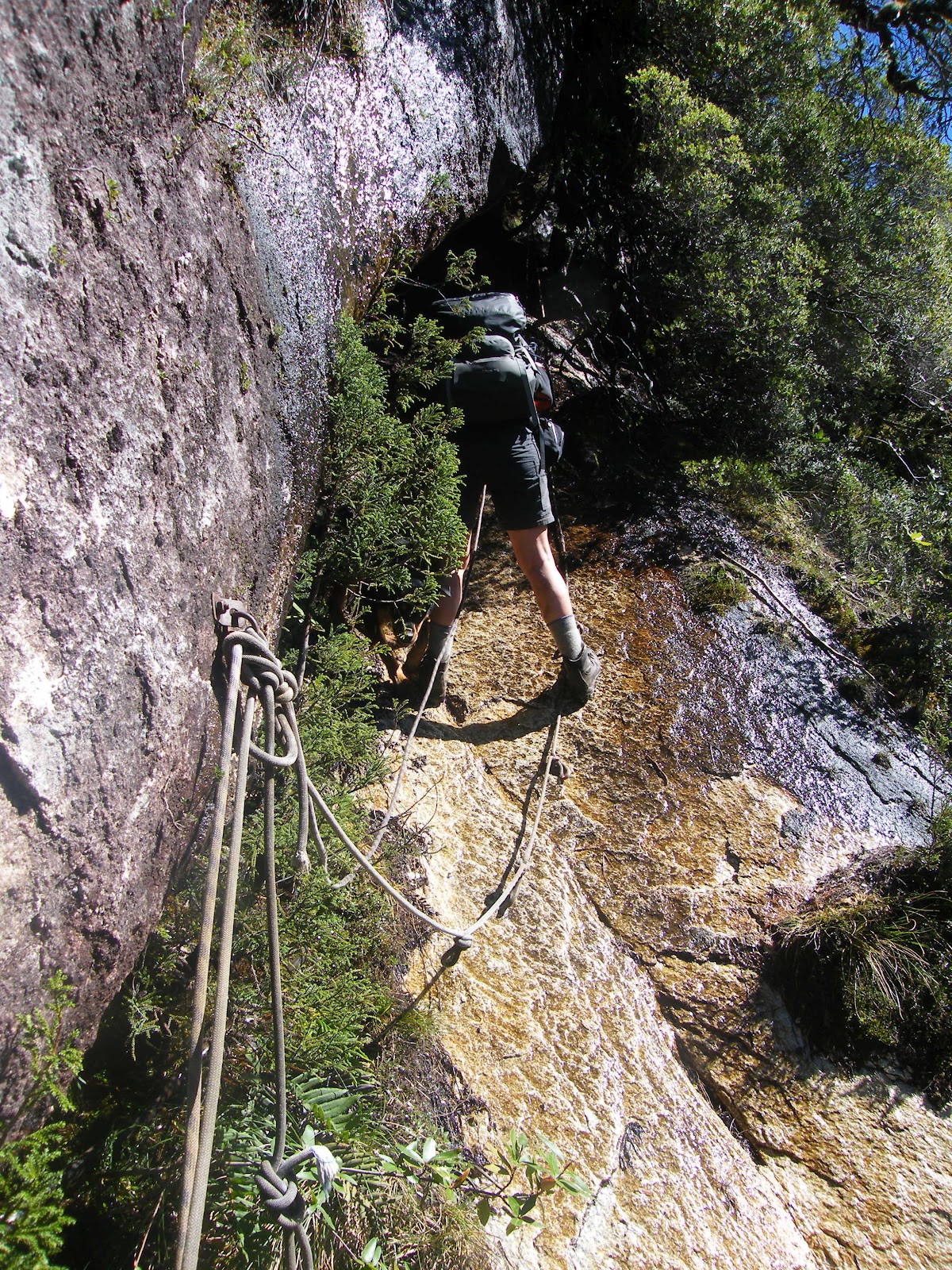
Hot water and trekking information were available on the other side of the river at the refugio, built and owned by an American called Danny. Getting there was for me a highlight of this three days: you had to sit in a wooden chair, operated by two ropes and a pulley. First you used the rope to pull the chair towards you, then you got into it, and let yourself be lowered across to the other side - helped by a second person if there was anyone around to operate the rope. Otherwise, you just grabbed the higher of the two ropes as you approached the other side, crossing your hands along it, to get to the platform on the other side, which you could climb onto, using the steps to get down to the beach - that is, if you didn't want to jump. (I didn't.) Not as hard as it sounds, and all good fun! .


Technique demonstration!

With all the mud, my boots were filthy, and soaking wet - as were my feet. I had been speaking pidgin Spanish with Ernan all afternoon, but after he had eaten and rested a bit, he suddenly started speaking English. Since he had a stove with him, and following the Torres del Paine experience I had decided I could survive without one for a couple of nights, he kindly boiled some extra hot water for my instant hot soup; but I was particularly touched when later he brought me over some more warm water: for my feet, he explained. He wouldn't have liked his feet to get so muddy and cold! Somehow, my boots and feet had got even wetter and muddier than his had, and crossing the river to the refugio for hot water didn't seem such a good idea, since it would mean crossing back in the dark!

Alice had stayed at the refugio, but the next morning, the three of us set off together along what was described later by someone as 'a climber's idea of a hiking path': clear for much of the way, but it could have done with some nice helpful blobs of paint on a tree here and there.

At one point I got separated from the others, when a pack strap got tangled up on some vegetation. By the time the others stopped to wait, I found out later, they had missed the turning to the left that we had been told to take. Meanwhile, I was dismayed to find that a hard uphill path finished at a boulder, without appearing to go anywhere else. ]I went down, thinking that maybe I had lost the path, and tried a different one, but ended up at the same boulder.

Demoralised and disappointed, I decided that there was nothing else for it but to give up and go down. I'd hardly been going 10 minutes, before I met a dog. Where on earth had he come from? Round the corner then came its owner: Laura, a woman in her early 30s from Montana in the USA, who coming from an adventurous family, did lots of backpacking on her own - together with Jack, her dog. She had managed to download a walk description from somewhere, and just as we were talking, who should come round the corner, but Alice, followed not long afterwards by Ernan! I'd assumed that they were well ahead of me.

The walk description indicated a path to the side of the boulder that I'd not noticed, and the four of us went back to it (the third time for me), found the path, and then crossed the spectacular rocky (but easy) ridge, continuing eventually up to a roped section that Danny had told us about. At this stage, Laura decided that she would have to turn back, since it was too difficult for Jack.


We had started off late, and I too was unsure about continuing all the way to the top (supposedly 4 or 5 hours), and reluctant to come down the roped section on my own, should I want to turn back before the others. And so it was agreed that I would go back with Laura and Jack the dog, via some waterfalls (though not before I had been up the rope, just for the experience), and Ernan would continue for at least another hour with Alice. Getting up the rock was not a problem, and nor was getting down; the difficult part was getting onto the rope in the first place, particularly on the way down. Meanwhile, Will and his girlfriend Frances, from Maine in the USA, had arrived, together with Elaina from Washington: so now Alice had four people to go with her. (For Will's account of this trek, see http://chile2653.blogspot.com.ar/2012/03/cochamo-valley.html , and also http://chile2653.blogspot.com.ar/2012/03/original-settlers.html)


Back at the campsite, it was good just to relax in the sunshine, and chat to a few other people around.


Later, I was invited to a pasta dinner with Ryan and Jessica, a couple from California. I had only peanuts, cheese, dried soup, crackers and dried peaches to offer as a contribution, but they assured me that wasn't a problem. They were heading gradually north, they told me, where they were going to visit a village hit by a major earthquake two years ago.


At the time, they had been camping not far away, and having realised that they themselves were fine, had loaded up their van with toilet rolls, groceries and anything else they could think of, and then stayed a month in the village helping the people who had been left dazed and shocked: Ryan had come from the construction industry, so had some useful practical skills to offer. They had obviously made some good friends there, and were looking forward to seeing them again.

(Note added 26th March; it seems that there has been a further earthquake, only last night: http://ca.news.yahoo.com/strong-quake-shakes-chile-no-reports-deaths-013630684.html , not far from the original area.)

The next morning, I got up to find Ernan already on the move. He had not been sleeping well, so had got up at 5.30, and gone out to cut some bamboo canes for both of us to use as trekking poles on the way back: useful for river crossings, and testing the depth of mud!

Cochamo Valley

It was another lovely day, and the trek back through the forest was far more enjoyable than on the way up, especially since after two sunny days, it was a bit less muddy and wet. Back by the gravel road, we linked up with Alice, and the three Americans. Soon afterwards, we all piled into the back of the 'scheduled truck' that for a small price would take us back to the village of Cochamo, for the bus back to Puerto Varas. With the weather clear and sunny, and the tide in at the fjord, we got some lovely views past the old church and over the lake, of another snow-capped volcano.


Typical Patagonian village home, Cochamo

Scheduled truck. Will and his girlfriend Frances, from Maine.
Cochamo
In due course, the bus arrived (only 40 minutes later than scheduled), and slowly made its way along the gravel road to Ensenada, where Volcan Osorno could be seen in all its splendour, and onwards to Puerto Varas, where I spent one more night, prior to heading over to the university town of Valdivia for a couple of days; before completing the circuit of the Chilean lake district for further volcano views. Time to celebrate the end of the trek, with a portion of scrummy gateau, from the San Isobel supermarket!