Tuesday, January 31st: time to start Phase 2 of this journey, moving back into Chile, ready for the journey up the Carretera Austral: a largely unpaved 1240km route through rural Patagonia, stretching from Villa O'Higgins in the south of Chile, to Puerto Montt, starting point for the Chilean Lake District:
http://en.wikipedia.org/wiki/Carretera_Austral . The road is mainly unpaved, surfaced with
ripio (stones and gravel), and there are often more cyclists and motor cyclists on it than cars, buses or trucks. It is renowned for the rainforest, lakes and glaciated mountains that you pass on the way.

(Map courtesy www.villaohiggins.com)
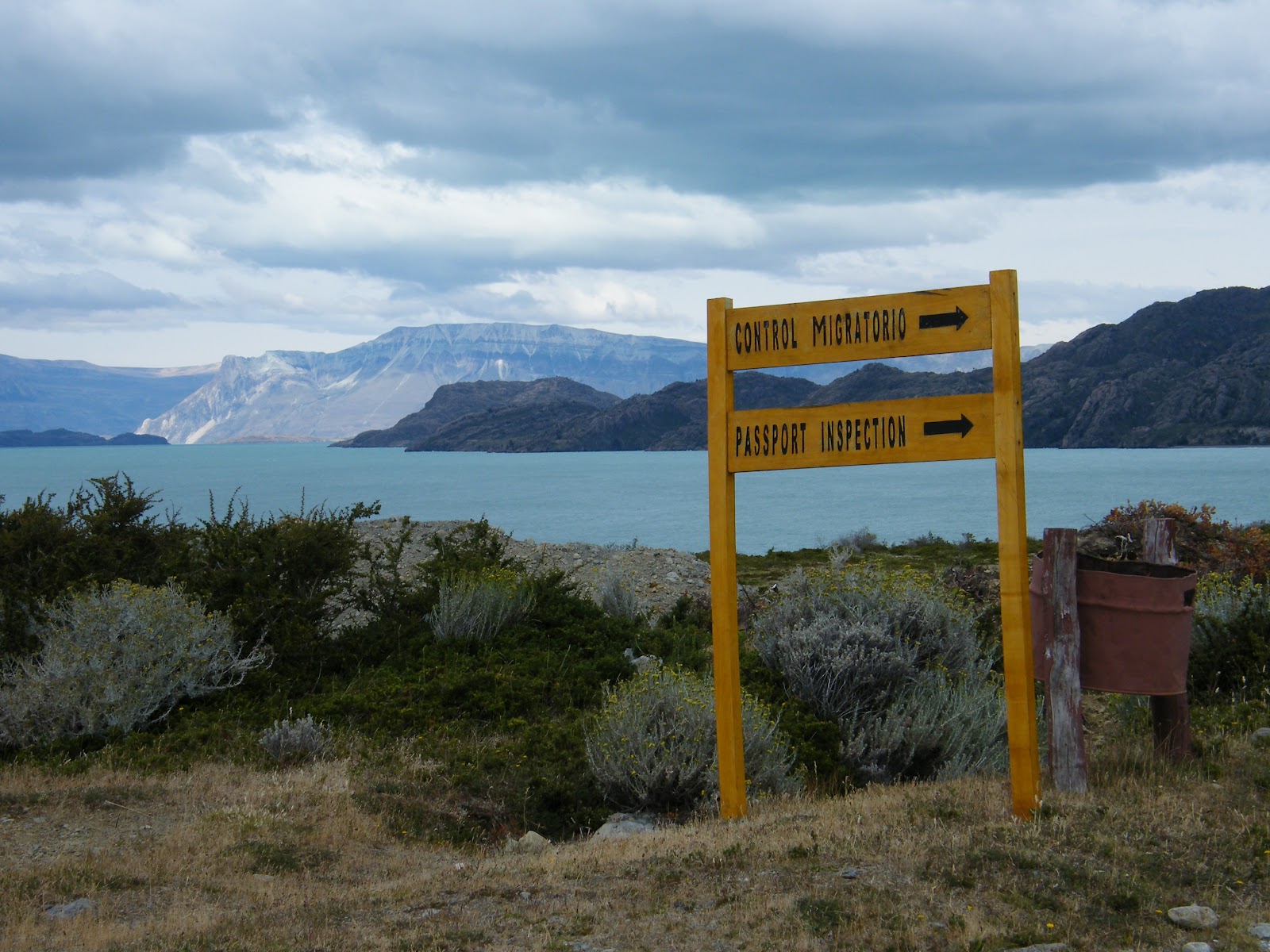
At the recommendation of the hostel staff, took the 8.30 transfer to Lago Desertio: only to find that Tuesday was the one day that the boat to the other side of the lake didn´t leave until the afternoon. No problem: according to the sketch map provided, you could trek to the Argentinian border post at the end of the lake, in just four hours; so Dutchman Hans and I set off on our way, across the swinging suspension bridge.
 |
| Suspension bridge at Lago del Desierto: start of the trek |
After that, despite some pretty woodland and waterfalls, the path was a bit of a nightmare: steeply up, steeply down, across tree stumps, through unbridged streams, and boggy bits.
The path was reasonably well marked, after the first couple of hours - except for where the path divided. Hans offered to take some of my stuff for me, but was already carrying a load of his own, so I didn´t like to accept. Eventually, I encouraged him to continue at his own pace. Seven hours after starting, I arrived - having met just a group of French and Australian people, and one German girl cyclist (travelling without her bike, which was to follow her later by boat): blue-lipped from eating the Calafate berries that legend says will ensure that the consumer returns to Patagonia. All of them were coming from the opposite direction.
 |
| Calafate berries: photo Istvan and Henrietta |
I arrived at the Argentinian passport control just before the boat, to find just a few tents scattered around the lake: a beautiful place to camp, as well as being free.
As for the border guards, I wondered what they had to do to get such an idyllic placement - though how bored they must get, unless they were avid readers? Did they have to be studying, and in need of time for it? With just 2 boats coming in each day, each with just a handful of people, what did they have to do? People coming the 22 km from the opposite direction wouldn´t be likely to arrive much earlier than the local boat.
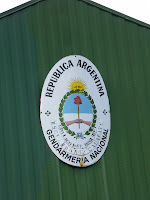

Around their hut were a few horses, and a family of large ducks were searching for food around the lake. A few meters away, they had a small round building with a pub football game outside it, and a barbecue-type cooking range inside.
There were six of us camping that night, waiting to be ´signed out' of Argentina, and we thought of trying to get our paperwork done this evening, so as to be able to make an early start next day - but by 6pm, one of the border guards had gone fishing, and the other was busy watching TV. They would be open again for business at 8am, we were told.
I awoke next day to hear the wind roaring, and didn´t feel keen to get up. Neither did the border guards, it seemed, since by 8.30, their office was still locked - though through the window, I could see that the TV was still on.
The elderly Italian guy was also waiting. I decided to go and explore a bit. Perhaps, if I had a poke around the guards' leisure facilities, it would at least wake the dog up, who would then alert the guards? It didn't work: the dog was also sleeping.
A few minutes later I returned, to find that dog or no dog, work had indeed begun. The Italian signed out of Argentina, it was my turn. However, this involved starting a new page in the book, which had to be meticulously ruled up, and thought given to the headings for each column. (Could have been at least 3 days since the last time this had been done.)
At last, duly signed out of Argentina, I could begin. The first 7km section through the trees up to the border should take about 2 hours or so, I´d been given to understand, .after which there was a straightforward jeep track. Sure enough, compared with the previous day, today´s trek was a walk in the park, despite being twice as far. Crossing from Argentina into Chile was uneventful, with just a metal stack, saying Argentina on one side, and Chile on the other: the border police were stationed 4 hours further on, just 1km from the boat.


Prior to that, the route took you across what looked like a runway for mountain bikes - and sure enough, at the end of it there was an ´Aerodrome´ sign: if this was an emergency landing strip, I didn´t want to be the emergency, particularly if the plane didn´t have mountain bike tyres! Heard later that yes, it was disused, but it had been the scene of bitter border disputes and shootings, as recently as the 1980s and 90s, and that at that time there had been families living there, who had built the runway.
Eventually, met 2 Australians and 2 Belgians coming the other way, who had been told that the boat might not run the next day, because of the wind. Arrived at the passport control soon after 4pm.
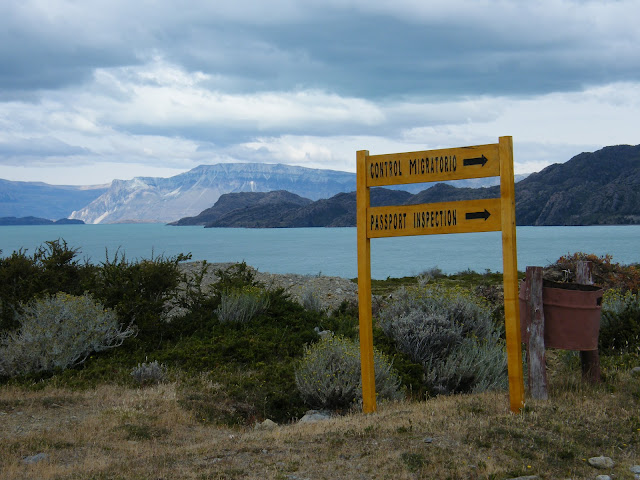 |
| Passport inspection post, Candelario Mancilla, Chile |
Tripped over a couple of chickens and a sleepy Welsh collie, rang the doorbell to warn the gendarmie to get the ink pad ready, and walked in to fill in the inevitable form, and have my passport stamped once again .Noticeable that at this border post, there was no nonsense about signing declarations to say that you were carrying no food. These border police evidently recognised that if you were walking for 7 hours, you needed food.
Met up with the Italian, Hans and 2 student social workers from Santiago, who had been at the campsite. The awaiting passengers were joined by another woman, who arrived from somewhere by tractor drawn cart/taxi, driven by one of the gendarmerie, 5 minutes before the boat came in.
 |
| VIP taxi - driven by one of the border post guards |
 |
| Waiting for the ferry at Candelaria Mancello |
The Robinson Crusoe boat arrived at the appointed time, and 2 English cyclists jumped off. They lived in Yorkshire, the girl told me, though the young man, Gareth Vickers, was from Monmouth. "Really?" I asked. Don´t suppose they knew Alan Morgan, whom I´d known for the past 40 years, since he was a young boy. Oh yes, he said. And his sister Vivienne!
The exchange was witnessed by one of the boat staff, who told me that some while ago, he was working somewhere, when his first love walked in - they hadn´t seen one another for 20 years! Wherever you are in the world, he said, just wait at a corner if you want to see somone you know!
Boat ride itself was like being on a ride in a funfair: up, down, side to side, BANG! Spray everywhere, as we rode the waves, but we survived. Really rather glad that I hadn't opted to extend the ride for another five hours by camping overnight again and taking the boat in the morning to look at a glacier.
Lady from Santiago came over and chatted to me, and then introduced me to her husband, her friend, and the friend´s daughter, who had studied near York. Off the boat, we all piled onto a Robinson Crusoe bus, for the last stage of this border crossing into Villa O´Higgins, along a road that had been blown out of the cliff with explosives: a narrow road following a lake, with some spectacular drops below . . . .
 |
| Bridge near Villa O'Higgins |
 |
| Road near Villa O'Higgins |
|
|
|
Camped at El Mosco hostel. Camping area a bit desolate looking, but inside was beautifully cosy, built by the owner Jorque himself. Took it easy next day, meeting a number of local people as I looked into the possibility of buying a secondhand bike for the trip up the Carretera Austral. Hans Silva from this village had promised to try and find me one, but the bikes he had were not for sale. Jorque's friend Maurizio, who owned the Eco campsite, did have a bike, but said it was much too big for me. He knew someone who had quite a good one for sale my size, but this man had just left for Cochrane and wouldn't be back until Sunday. And so it went on, and I decided that perhaps it just wasn´t meant to be.
Watched a plane come and land: extraordinary that such a small village should have a runway.
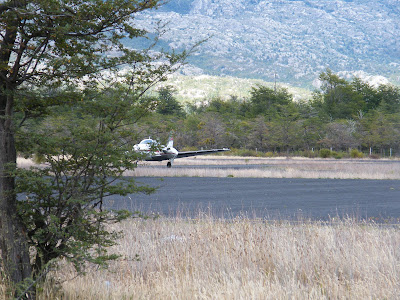 |
| Runway at Villa O'Higgins |
Even more extraordinary, Maurizio told me, was that five men had taken three years to build the runway , with nothing but hand tools! He spoke of the amazing courage of the pilots who landed there. (Surely of the passengers too, I couldn´t help thinking.)
Himself originally from Valparaiso, he also said he never ceased to be amazed by the way country people survived here. There was a woman of 67 living in the village who had been 'born on the glacier', and her 94 year old mother was still alive.
Hit lucky the evening before leaving. Some Hungarian people living and working in Santiago, Izvan, an astronomer, and Henrietta, a biologist, asked me about my plans, and when I said I was going to Tortel, offered me a lift, since they were going too.


 offered (and accepted) a ride in a boat to a small rock, where lobos (sea lions) sometimes hang out (but not that day), and some excellent musicians busking in the street, on a wet afternoon.